It may surprise you, but the answer is yes: certain medicines can cause diabetes. Think about your own routine, the tablet for cholesterol, the tablet for blood pressure, the pump for asthma, the medicine for knee pain. These are ordinary, everyday medicines, not rare or special drugs, yet as a side effect, some of them can slowly push your blood sugar up.
The question, can medicine cause diabetes, has a clear answer from the American Diabetes Association (ADA), which lists 5 categories of medicines that cause diabetes risk: statins, thiazide diuretics, corticosteroids, antipsychotic medicines and antiretroviral medicines. Doctors call this drug induced diabetes risk, a medicine taken for one problem quietly working against your blood sugar, or simply drugs that cause diabetes, because the risk comes from the drug itself, not the disease it treats.
Please note before you read further: never stop, skip or change any prescribed medicine on your own after reading this blog. These medicines treat real and serious conditions. The risk from any medicine depends on the medicine itself, the dose, how long you take it and your own health. The correct response to this information is testing and a conversation with your doctor, not fear.
Diabetes Medicines vs Medicines That Cause Diabetes: Understand This Difference First
One confusion first: in India, people commonly search for diabetes medicines as sugar tablets or diabetes medicines, and diabetes medication or diabetes medicine mean the same thing: the medicine taken after diabetes has developed, to bring sugar down.
Here is the difference at a glance:
| Diabetes medicine (treatment) | Medicine that causes diabetes (risk) | |
|---|---|---|
| Taken for | Bringing blood sugar down, after diabetes has developed | Cholesterol, BP, asthma, arthritis, mental health or HIV |
| Effect on sugar | Lowers sugar | Can raise sugar as a side effect |
| What to do | Take it on your doctor's advice; never stop it on your own | Never stop it on your own; keep testing your sugar |
One clarification: diabetes medicines themselves, such as metformin, are not on this ADA list, and metformin side effects is a separate subject. The risk covered here is only the other direction: medicines taken for something else that can raise blood sugar, whether you searched for sugar medicine or diabetes tablets to understand it.
What Does the ADA Say About Medicines That Raise Blood Sugar?
Every year, the American Diabetes Association publishes its Standards of Care, the guidelines its doctors follow so diabetes treatment stays uniform across the world. In the 2026 guidelines, the ADA gives a clear instruction about medicines: screening for prediabetes or diabetes should be performed in people treated with certain medications, namely glucocorticoids, statins, thiazide diuretics, some HIV medications and second-generation antipsychotic medications, because these drug classes increase the risk of glucose abnormalities, often by promoting insulin resistance.
These are the medications that raise blood sugar that the ADA officially flags for screening, the same list patients ask about as what medications cause high blood sugar.
So which medicines increase blood sugar? The ADA's answer is this list of five. And notice what the ADA is asking for: not that you throw your medicines away, but screening, which means regular blood sugar testing for every patient who takes one of these 5 categories, so a rise is caught early instead of after years.
The 5 Medicine Categories at a Glance
The complete list of drugs that raise blood sugar, at a glance:
| Medicine category | Commonly used for | How it can raise blood sugar | What you should do |
|---|---|---|---|
| 1. Statins | Lowering cholesterol | Increase insulin resistance, and can reduce insulin production in the pancreas | Get blood sugar tested regularly; never stop the statin on your own |
| 2. Thiazide diuretics | High blood pressure | Push potassium out with sodium, which can lower insulin production; can also raise insulin resistance | Test blood sugar regularly and discuss your reports with your doctor |
| 3. Corticosteroids (glucocorticoids) | Asthma, arthritis and joint pain, organ transplant | Increase the liver's internal glucose production, so sugar rises mainly after meals | Test your post-meal (PP) sugar, not only fasting sugar |
| 4. Antipsychotic medicines | Anxiety, depression, bipolar and other mental health conditions | Increase appetite and carbohydrate intake, leading to weight gain and insulin resistance | Regular sugar testing and weight monitoring with your doctor |
| 5. Antiretroviral medicines | HIV treatment | Can increase insulin resistance and reduce insulin production | Screen before starting treatment and regularly during it, as the ADA advises |
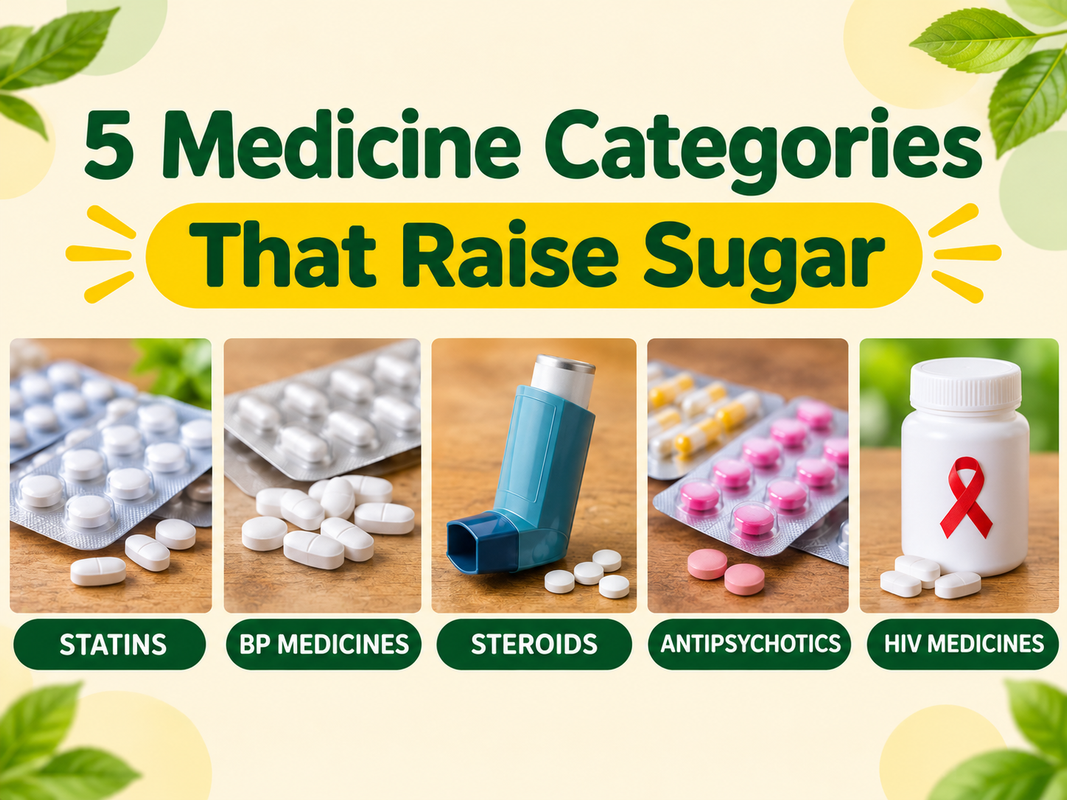
One pattern is already visible: four of the five categories work through the same two levers, either increasing insulin resistance or reducing insulin production in the pancreas, or both, while the antipsychotics reach the same result through appetite and weight.
1. Do Statins Raise Blood Sugar? The Cholesterol Medicine Story
Statins are usually the first medicine a doctor starts when your cholesterol is found high. To understand the statins and diabetes link, first understand where cholesterol comes from.
When you eat excess carbohydrate, it becomes glucose. Your liver breaks that glucose down and rebuilds part of it as cholesterol, through a chemical chain. That is why the cholesterol in your blood has two sources:
| Where blood cholesterol comes from | Approx. share | What it means |
|---|---|---|
| Made by your liver | Around 75% | Most cholesterol is produced inside the body |
| Comes directly from food | Around 25% | Only a small part comes straight from your diet |
Since most cholesterol is made in the liver, the smart way to reduce it is to reduce production there. That is exactly what a statin does. It blocks an enzyme called HMG-CoA reductase, a key step in the liver's cholesterol-making chain.
The chain stops, cholesterol synthesis falls, and your total cholesterol comes down. The medicine works. The problem is the side effect you need to know about.
Statins have two major side effects on blood sugar. First, they can increase insulin resistance, and rising insulin resistance is the root of diabetes.
Second, insulin production in the pancreas depends on calcium signals inside its cells, and statins can disturb that calcium process, so insulin production can fall. More resistance on one side, less insulin on the other: that is how a cholesterol tablet can raise diabetes risk.
So, do statins raise blood sugar? They can, slowly and silently. That is why the ADA puts statin users on its screening list.
This does not mean you should fear or stop your statin. It was prescribed to protect your heart. It means your blood sugar deserves the same regular checking as your cholesterol.
2. Can BP Medicines (Thiazide Diuretics) Increase Diabetes Risk?
Thiazide diuretics are the classic first-line medicines for high blood pressure, known to many as water pills because they make you pass more urine and remove water from the body. To see their side effect, first follow how blood pressure rises: it often begins with sodium, which stays in your body for two reasons, either you eat too much of it, or your insulin is high, because insulin itself holds sodium back.
Where there is sodium, there is water: sodium pulls water with it, so imagine your blood circulation as a closed loop that comfortably holds about 5 litres of blood. Sodium retention pulls in extra water, and suppose the volume climbs towards 7 litres in the same closed loop: same pipes, more fluid, so the pressure inside has to rise, and that pressure is blood pressure.
A diuretic reverses this: it throws sodium out of your body, water follows the sodium, blood volume falls, and blood pressure comes down.
But there is a catch: when sodium leaves, potassium leaves with it, and potassium plays a big role in the insulin production process inside the pancreas, so if potassium falls, insulin production can fall with it.
At the same time, thiazide diuretics can also increase insulin resistance. Less insulin production plus more insulin resistance. Once again, both levers move in the wrong direction, and the probability of diabetes rises. This is why a BP tablet sits at number 2 on the ADA list.
3. Steroids and Blood Sugar: Why Your Fasting Report Can Look Normal
The third category is the corticosteroids, also called glucocorticoids. You meet them in the asthma pump, in medicines given to reduce pain and swelling in knee pain and arthritis, and after an organ transplant.
In a kidney transplant, for example, the new kidney comes from another person. So your immune system treats it as a foreign object and tries to destroy it. Corticosteroids suppress that immune response. That is how the transplanted kidney can keep working for years, often around 15 years.
These are powerful, sometimes life-saving medicines, and their sugar effect is the most direct of the five: corticosteroids increase the liver's internal glucose production, so the liver releases extra glucose into the blood, blood glucose rises, and diabetes can follow. This is the core of steroids and blood sugar: the rise does not come from what you eat, but from glucose your own liver manufactures under the steroid's instruction. Doctors often call this pattern steroid induced diabetes, and the steroids and diabetes connection is well known because steroid treatment is so common and the sugar rise feels so unexpected.
Now the trap: on corticosteroids, your fasting blood sugar can stay normal for a long time, but your post-meal sugar, the PP reading taken 2 hours after food, keeps climbing.
The typical pattern looks like this. You test fasting in the morning: normal, so you relax. You eat breakfast, take your steroid tablet, and 2 to 3 hours later your blood glucose is high. And nobody measured it.
If you take a corticosteroid, fasting testing alone can give you false confidence. Focus on the PP reading. The ADA says the same thing in its 2026 guidelines: for people on glucocorticoids, screening should use post-meal or random glucose rather than relying on fasting alone, because fasting-only screening leads to missed and delayed diagnosis.
4. Can Mental Health Medicines (Antipsychotics) Lead to Diabetes?
The fourth category is the antipsychotic medicines. These are the drugs used for conditions of the mind such as anxiety, depression and bipolar disorder. The ADA's precise term for the group it flags is second-generation antipsychotic medications.
Their route to diabetes is different from the first three. They do not attack the pancreas directly. They increase appetite.
When appetite rises, you simply eat more. And what gets eaten more is usually carbohydrate. More carbohydrate means more glucose, more insulin demand, and slowly, more insulin resistance.
Add steady weight gain on top, and the risk of obesity and diabetes both climb. So with this category, your defence is regular blood sugar testing, plus an honest watch on appetite and weight, discussed openly with the doctor who prescribed the medicine.
5. Can HIV Medicines (Antiretroviral Medicines) Affect Blood Sugar?
The fifth category is the antiretroviral medicines used to treat HIV. These medicines can also work on both levers at once. They can increase insulin resistance, and they can reduce insulin production.
That combination is why the ADA includes some HIV medications in the same screening list as statins and steroids. The ADA advises screening before antiretroviral treatment begins, and regularly while it continues. If you are on HIV treatment, blood sugar testing is not an optional extra. It is part of the treatment's safety system.
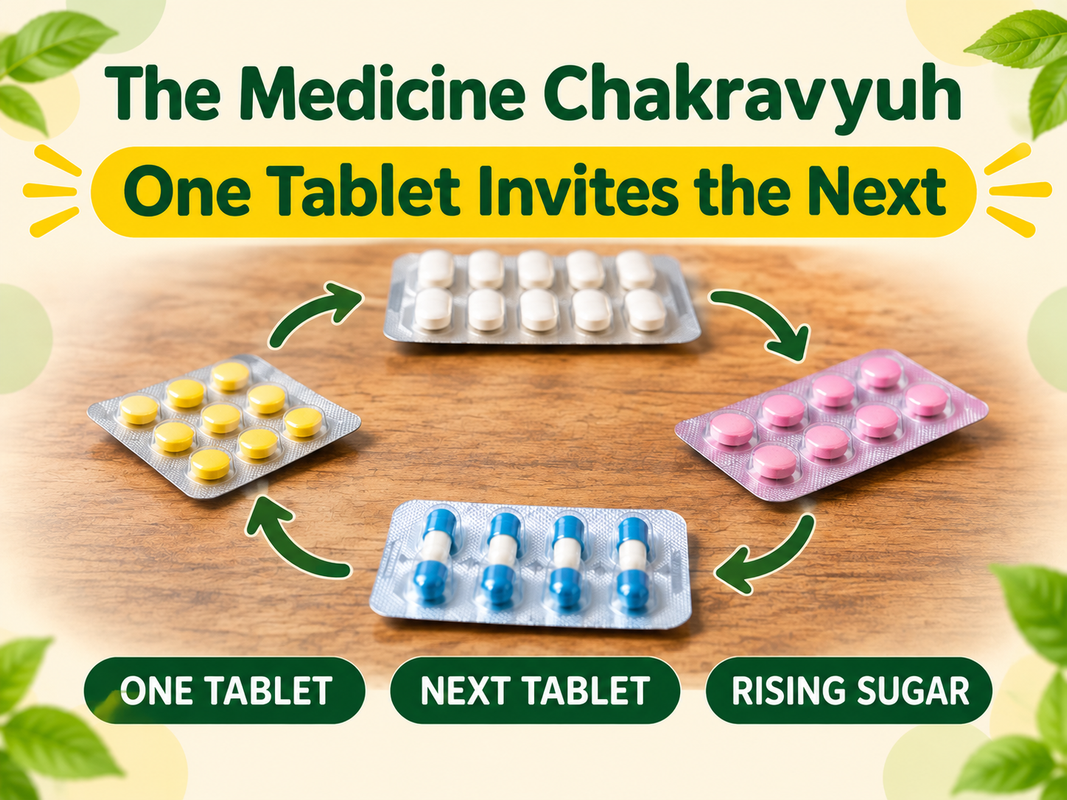
The Medicine Chakravyuh: How One Tablet Invites the Next
Now connect the dots: your diet carries too much carbohydrate, extra glucose floods in, so your body needs extra insulin, and over time insulin resistance develops.
Insulin resistance raises cholesterol, so a statin is started. The statin's side effect raises insulin resistance further.
Higher insulin makes your body hold sodium. Blood pressure rises, so a thiazide diuretic is added. Its side effect raises insulin resistance again and drains potassium.
Insulin resistance climbs and climbs until, one day, diabetes arrives.
Now diabetes medicines are added, many of them working by pushing the pancreas to produce even more insulin, so there is more insulin and still more insulin resistance, and now obesity joins diabetes, as one medicine keeps getting added, one side effect keeps getting added, and you keep circling inside the formation.
The way out is not another tablet. It is built on three things: awareness, knowledge and discipline.
A medicine taken for 2 to 4 days, or a week, for a fever or an infection is a different matter, because it stops in 5 to 7 days. But when a medicine has to be taken daily for years, it usually points to a gap in dietary discipline somewhere upstream.
Every medicine carries some side effect, and one medicine's side effect can become the reason for the next medicine. The only exit from the chakravyuh is to fix the root: the glucose load that started the whole chain.
Read next: Insulin Resistance: Seed of Diabetes
What Should You Do If You Take One of These 5 Medicines?
Here is your practical checklist, backed by the ADA guidance:
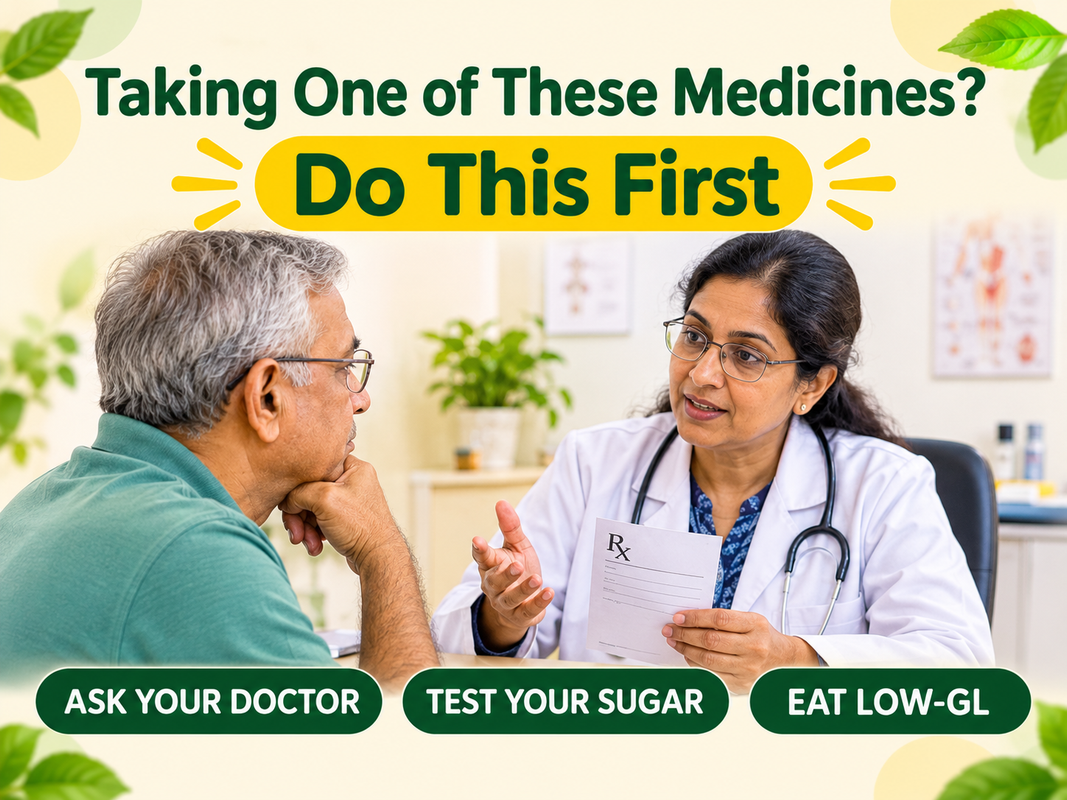
- Never stop or change the medicine on your own. Not the statin, not the BP tablet, not the steroid, not any of them. Stopping suddenly can be more dangerous than the side effect you are worried about.
- Test your blood sugar regularly. If your doctor has put you on any of the 5 categories, regular glucose testing is the ADA's clear advice. For most categories, fasting testing is a workable routine.
- On steroids, test PP as well. Check your sugar 2 hours after a meal, because that is the reading corticosteroids push up first, while fasting can stay deceptively normal.
- Take your reports back to your doctor. Ask one direct question: doctor, I am on this medicine long term, should I be screened for prediabetes or diabetes? That one question activates the ADA protocol.
- Reduce the root pressure. The medicines may be necessary, but your plate is in your hands. Lowering your daily glucose load lowers insulin demand, and insulin resistance is the very thing most of these medicines aggravate.
And if one day a test does come back high, do not panic, and do not simply accept one more tablet as fate. Ask what is driving the rise, whether a medicine is contributing, and what a root-cause plan looks like for you, because that conversation is where the chakravyuh actually breaks.
Why Glucose Load Is Still the Biggest Lever in Your Hands
The thread underneath this entire story is glucose load: excess glucose from food raised insulin, built insulin resistance, raised cholesterol and blood pressure, and started the medicine chain.
The medicines then pressed on the same two levers, insulin resistance and insulin production. You may not be able to change your prescription today, but you can change the glucose load of what you eat today, starting with the food you eat at every single meal: your atta.
Diabexy atta is a low-glucose-load atta, specially designed for diabetes management. It is India's 1st diabetes atta backed by published clinical evidence. A study published in the Journal of Mid-Life Health confirms that participants using Diabexy atta got lower HbA1c (8.5 to 6.5), lower fasting blood sugar and lower after-meal blood sugar. The study also found that many participants needed fewer diabetes medicines over time. Use Diabexy atta daily for better diabetes management.
Diabexy Sugar Control Atta
A low glucose load atta with an EGL of just 7 per 100 g, against about 50 for regular wheat atta. When your goal is to reduce insulin demand at every meal, the atta you use twice a day is the biggest daily lever you control.

Diabexy EGL Chart
The glucose load of 300+ Indian foods in one colour coded chart, so you can see which foods quietly push insulin up and which ones keep it calm. Use it to rebuild your plate while your medicines do their job.
Confused about your medicines and your sugar reports? Do not guess with your health, and do not stop any medicine in confusion. Talk to a Diabexy diabetes coach, understand how your medicines, your food and your reports connect, and make a plan with your doctor. Call us on +91 84489 52009 or book a free consultation below.
Frequently Asked Questions
Can medicines cause diabetes?
Yes. The American Diabetes Association's 2026 Standards of Care names 5 medicine categories that increase the risk of glucose abnormalities. They are glucocorticoids, statins, thiazide diuretics, some HIV medications and second-generation antipsychotic medications. They mostly work by promoting insulin resistance or by reducing insulin production, which is why the ADA advises regular screening for people who take them. These are the drugs that increase blood sugar that doctors watch for when a patient is on long-term treatment.
Do statins raise blood sugar? Should I stop my cholesterol tablet?
Can statins cause diabetes? They can raise the risk through 2 effects: they can increase insulin resistance, and they can disturb the calcium process the pancreas needs to release insulin, so production can fall. No, do not stop your statin on your own. It was prescribed to protect your heart. The right response is regular blood sugar testing and a discussion with your doctor, exactly as the ADA recommends. That is the statin side effects diabetes issue in short: a heart-protecting medicine with a sugar side effect that regular testing catches early.
I take a BP medicine. How would I know if it is affecting my sugar?
You would know only by testing, because this rise is silent. Thiazide diuretics push potassium out of the body along with sodium, and lower potassium can reduce insulin production. If you take a BP medicine from this category, get your fasting blood sugar tested regularly, and show the trend to your doctor instead of guessing from how you feel.
Why is my fasting sugar normal but my after-food sugar high on steroids?
Because corticosteroids mainly raise the after-meal reading. They make the liver release extra glucose, so your PP sugar, checked 2 hours after eating, climbs first, while fasting sugar can stay normal for a long time. That is why the ADA advises post-meal or random glucose checks for people on glucocorticoids instead of relying on fasting alone.
Which blood sugar tests should I get if I take one of these 5 medicines?
Get regular blood glucose testing for as long as you take the medicine. For 4 of the 5 categories, a fasting test is a workable routine check. For corticosteroids, add the PP test 2 hours after a meal. If you are starting a second-generation antipsychotic or HIV treatment, the ADA advises a baseline test before or when treatment starts, and repeat testing after that.
Can a short course of medicine for fever or infection cause diabetes?
A short course is a different situation. Medicines taken for 2 to 7 days for a fever or an infection stop quickly, and this discussion is not about them. The risk in this blog is about medicines taken daily for months and years, where a small daily side effect on insulin resistance or insulin production gets time to accumulate.
I cannot stop these medicines. How do I protect myself?
Protect yourself with 3 things: awareness, knowledge and discipline. Know that your medicine carries this side effect. Test your sugar regularly, PP as well if you are on steroids. Keep your doctor in the loop, and reduce the one pressure fully in your control: the glucose load of your food, which is the root driver of insulin resistance in the first place.
References
1. American Diabetes Association Professional Practice Committee. 2. Diagnosis and Classification of Diabetes: Standards of Care in Diabetes, 2026. Diabetes Care, 2026; 49 (Suppl. 1): S27 to S49. Its Medications section names glucocorticoids, statins, thiazide diuretics, some HIV medications and second-generation antipsychotic medications as drug classes that increase the risk of glucose abnormalities, advises screening for people treated with them, and recommends postprandial or random glucose checks for people on glucocorticoids rather than fasting alone. Read the ADA section: https://diabetesjournals.org/care/article/49/Supplement_1/S27/163926/2-Diagnosis-and-Classification-of-Diabetes
2. Sattar N, et al. Statins and risk of incident diabetes: a collaborative meta-analysis of randomised statin trials. The Lancet, 2010. A combined analysis of 13 statin trials supporting the statin category in the ADA list. See the study record: https://pubmed.ncbi.nlm.nih.gov/20167359/
3. Medication-Induced Hyperglycemia and Diabetes Mellitus: A Review of Current Literature and Practical Management Strategies. A review of how different drug classes alter glucose metabolism through insulin resistance, weight gain and direct effects on the insulin-producing cells of the pancreas. Read the review: https://pmc.ncbi.nlm.nih.gov/articles/PMC11330434/
4. Diabexy EGL Chart: Estimated Glucose Load values of 300+ Indian foods, the framework used in this blog to explain why dietary glucose load is the root lever behind insulin resistance. See the chart: https://diabexy.com/products/egl-chart-download
Watch the Full Video
Watch the full explanation on the Diabexy YouTube channel here: https://youtu.be/DAtpzmMX83Q
About Diabexy
Diabexy is India's number one diabetes education platform, trusted by more than 2 million people. Diabexy makes India's first low glycemic load foods, including Sugar Control Atta, India's first atta backed by published clinical evidence. Our mission is to eradicate diabetes from India the way polio was eradicated, through the right knowledge and the right food. Visit diabexy.com.
Disclaimer: This blog is for education only. It does not replace medical advice. Always consult your physician for formal diagnosis, laboratory testing, and personal treatment plans.